

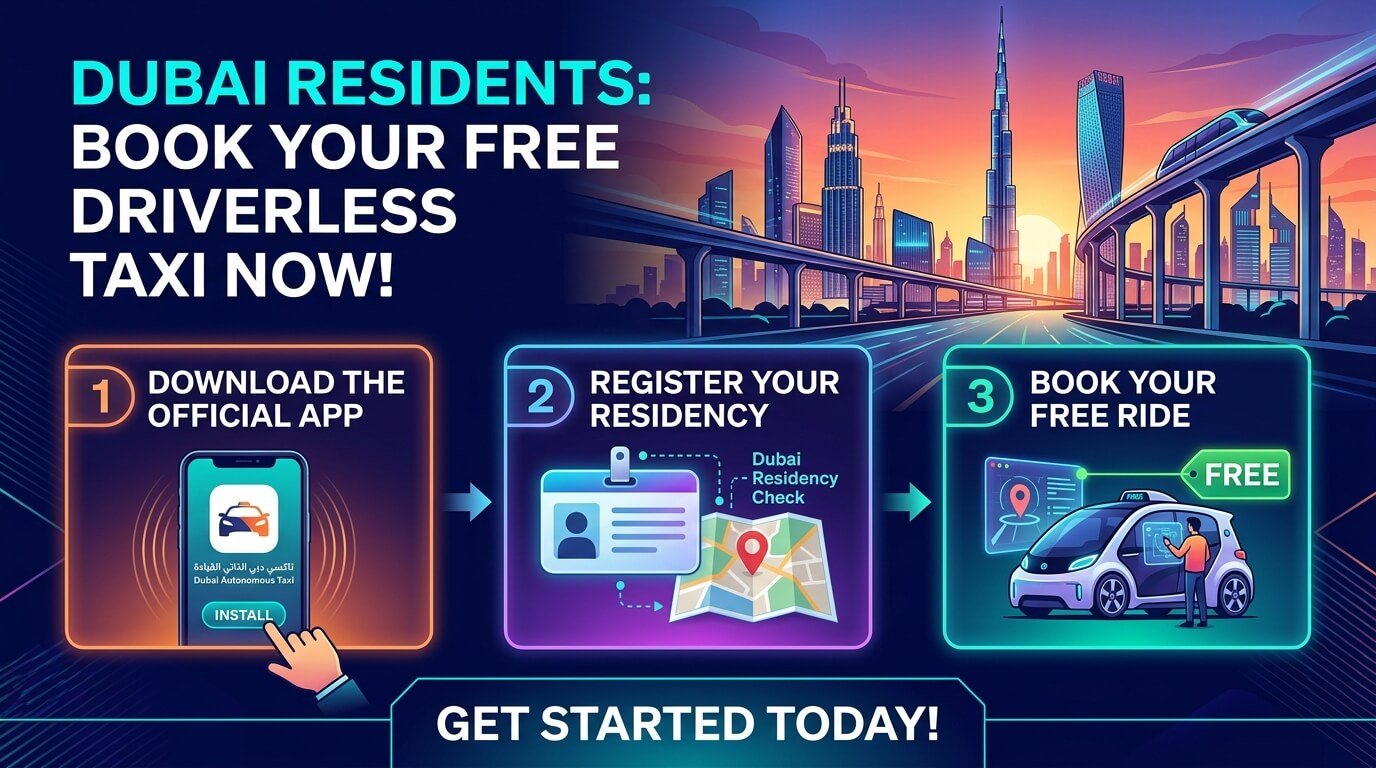
Dubai has officially taken another major step toward the future of transport with the launch of fully autonomous taxis across selected areas of the city. Residents and visitors can now experience driverless taxi rides in Dubai, and for a limited time, some journeys are even completely free.
The futuristic robotaxi service has now started operating in parts of Umm Suqeim and Jumeirah, giving passengers the chance to travel through Dubai without a driver behind the wheel.
The launch marks a huge milestone in Dubai’s ambitious plan to become one of the world’s leading smart mobility cities.
How To Book A Free Driverless Taxi In Dubai
Passengers interested in trying Dubai’s new autonomous taxis can book rides through the Apollo Go mobile app.
Free robotaxi rides are currently available for a limited period in selected areas, including Umm Suqeim and Jumeirah. Due to high public interest, availability may be limited, so passengers are encouraged to book early.
Users simply need to:
- Download the Apollo Go app
- Select their pick-up and drop-off location
- Confirm the autonomous taxi booking
- Wait for the vehicle to arrive
Passengers can also book autonomous taxis through the Uber app by selecting the “Autonomous” ride option.
Uber fares for the self-driving taxis currently range between Dhs63 and Dhs80 depending on distance and location.
Who Is Operating Dubai’s Driverless Taxis?
The new autonomous taxi service is the result of a partnership between Dubai Taxi Company and Chinese technology giant Baidu, which operates the Apollo Go autonomous driving platform.
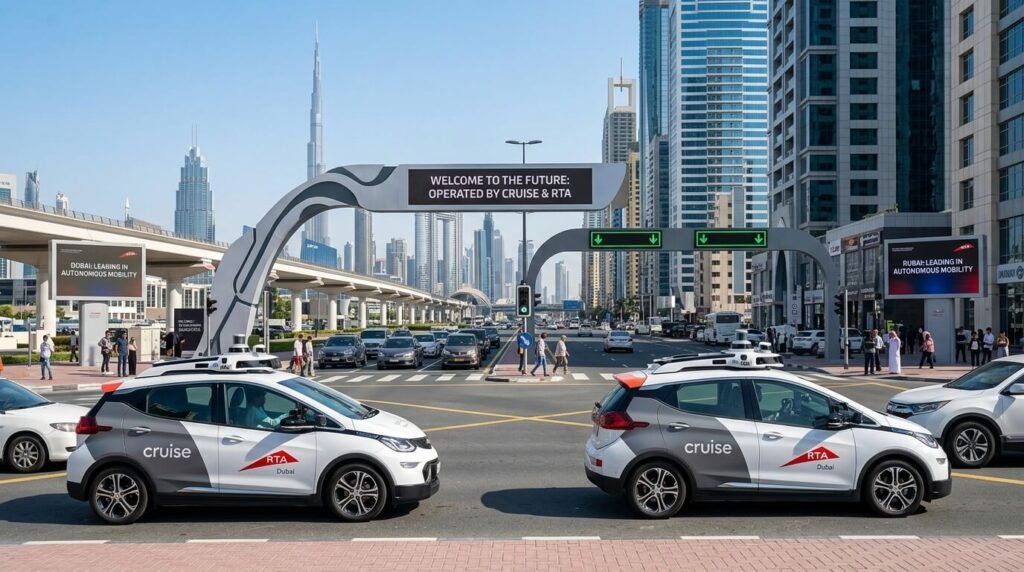
Apollo Go is one of the world’s leading robotaxi services and has already completed millions of autonomous journeys in several cities globally.
Dubai has been testing the technology extensively over the past year. Initial trial runs began in 2025 through a collaboration involving Uber and autonomous driving company WeRide.
The early testing phase allowed the vehicles to map Dubai’s roads, traffic systems, and urban conditions before the official public launch.
Following successful trials, Dubai officially added 100 autonomous taxis to the city’s transport network from March 30, 2026.
What Is It Like Riding In A Driverless Taxi?
Although the vehicle drives itself, some rides may still include a safety specialist seated in the front passenger seat during the early stages of the rollout.
However, there is no human driver controlling the car.
The taxis rely entirely on advanced artificial intelligence systems, sensors, cameras, and digital mapping technology to navigate the city safely.
Passengers can expect the vehicles to:
- Follow traffic signals and road rules
- Detect pedestrians and nearby vehicles
- Navigate intersections safely
- Respond to live traffic conditions in real time
- Operate smoothly in busy urban areas
The system uses high-definition digital maps, deep learning algorithms, and real-time data processing to make driving decisions instantly while travelling through Dubai streets.
Dubai’s Vision For Driverless Transport
The launch of robotaxis is part of Dubai’s long-term Autonomous Transportation Strategy.
Dubai’s Roads and Transport Authority (RTA) aims for 25 percent of all journeys in the emirate to become autonomous by 2030.
Authorities believe self-driving transport can help reduce traffic congestion, improve road safety, and lower environmental pollution across the city.
According to Dubai officials, autonomous vehicles could reduce traffic accidents by around 12 percent because human error is responsible for the vast majority of crashes worldwide.
The strategy is also expected to improve productivity and reduce time lost in traffic by making transportation more efficient.
Dubai estimates the project could eventually generate around Dhs22 billion in economic benefits through:
- Reduced transportation costs
- Improved transport efficiency
- Lower accident rates
- Reduced environmental pollution
- Increased productivity across the city
Officials also believe autonomous taxis will improve mobility for senior citizens, residents, tourists, and people of determination.
How Safe Are Dubai’s Driverless Taxis?
Safety remains one of the biggest priorities for the new autonomous taxi network.
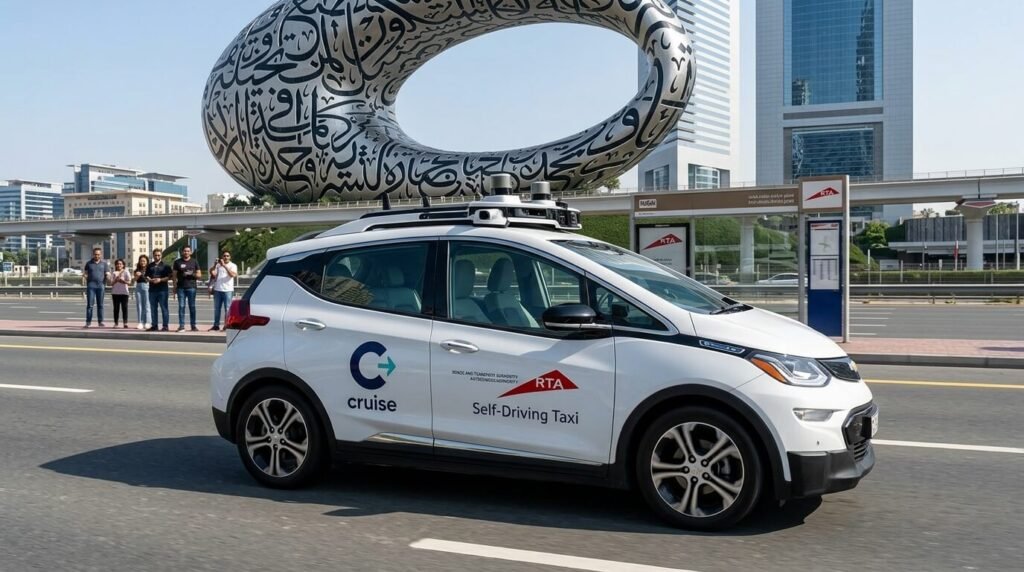
According to operators, the driverless system has already accumulated more than 150 million kilometres of safe driving globally and completed over 10 million autonomous trips worldwide.
The taxis operate using a combination of:
- Artificial intelligence
- Advanced sensors and cameras
- Autonomous decision-making systems
- Live traffic monitoring
- Smart navigation software
The vehicles continuously scan their surroundings and instantly react to changing traffic conditions.
Dubai authorities say the system has been designed to work safely alongside regular traffic in real urban environments.
More Driverless Taxis Are Coming Soon
The current rollout is only the beginning of Dubai’s autonomous transport expansion.
Authorities plan to significantly increase the number of robotaxis operating across the emirate over the next few years.
Dubai’s long-term target is to eventually deploy around 4,000 driverless taxis across the city.
Officials believe the expansion will help:
- Reduce road congestion
- Lower carbon emissions
- Improve first and last-mile connectivity
- Encourage public transport use
- Create safer roads
The project also supports Dubai’s wider smart city ambitions and its goal of becoming a global leader in futuristic transportation technology.
For now, residents have a rare opportunity to experience the future firsthand by booking a driverless ride through some of Dubai’s busiest neighbourhoods — and in some cases, completely free of charge.
FAQs About Dubai’s Driverless Taxis
Yes, Dubai has officially launched autonomous taxis in selected areas including Umm Suqeim and Jumeirah.
You can book a free robotaxi ride through the Apollo Go app for a limited time in selected Dubai locations.
The service is operated through a partnership between Dubai Taxi Company and Chinese technology company Baidu, which runs the Apollo Go platform.
Dubai aims to reduce traffic accidents, improve transport efficiency, lower emissions, and support its goal of making 25 percent of all transport autonomous by 2030.
According to operators, the autonomous driving system has completed more than 10 million trips and over 150 million kilometres of safe driving globally.