

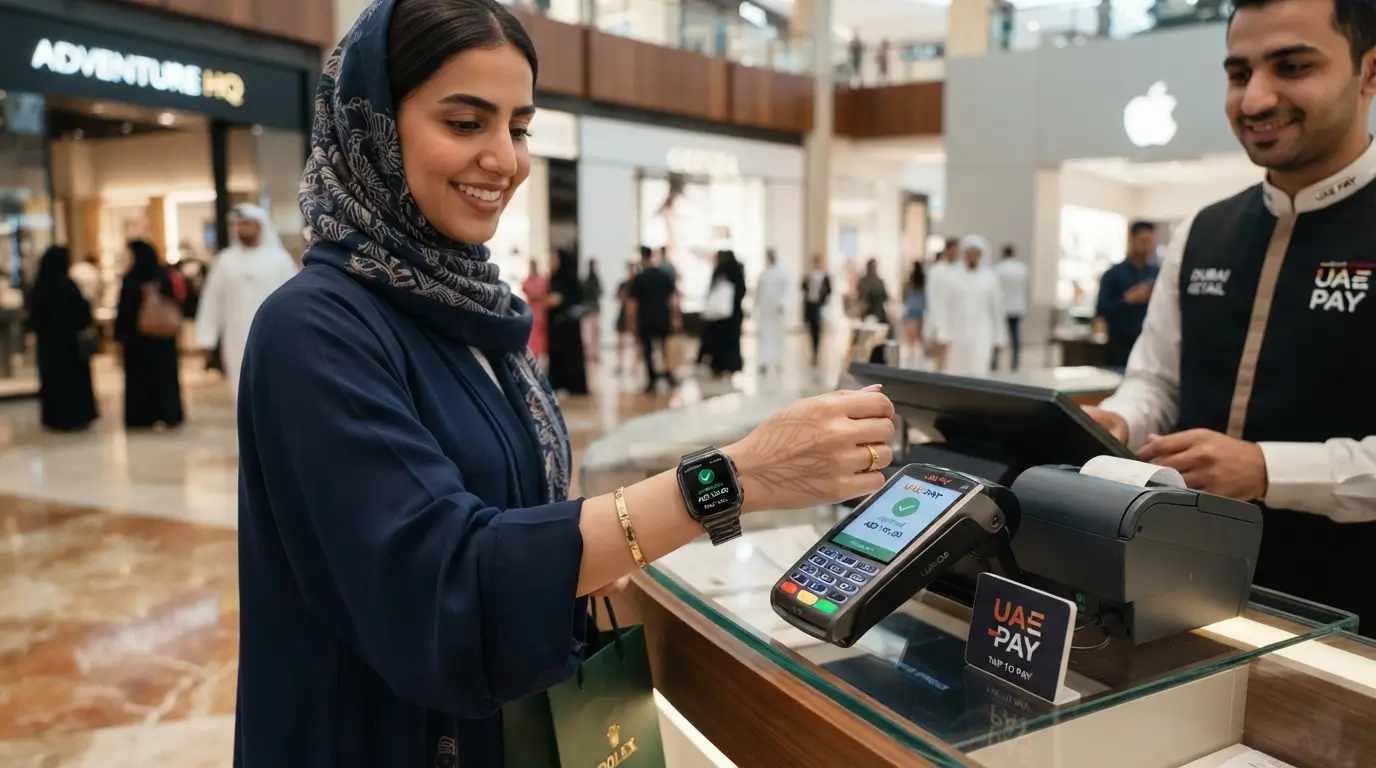
The Central Bank of the UAE (CBUAE) has unveiled a futuristic biometric payment solution that allows customers to authenticate transactions using their face or palm. The technology is designed to offer a payment experience without requiring shoppers to physically present a traditional bank card or mobile phone at the point of sale.
However, there’s an important detail to keep in mind: the technology is currently in its proof-of-concept phase. So, despite headlines suggesting that bank cards could soon disappear, there has been no announcement that physical cards are being removed from everyday use across the UAE.
UAE Takes Another Step Towards Card-Free Payments
Instead of reaching into a wallet for a debit or credit card, or unlocking a smartphone to complete a contactless payment, a customer could potentially authenticate themselves through their face or palm.
The concept could make some transactions quicker and more convenient, particularly in high-traffic environments where people want to complete purchases with as few physical steps as possible.
How Could Face Payment Work?
In a potential real-world transaction, a customer would first need to enrol within the relevant system and link their biometric identity to an approved payment method. At the point of payment, the system could then use facial recognition to authenticate the customer.
This means the customer’s face would not literally function as a bank card. Instead, the biometric identifier would act as an authentication mechanism connected to the payment system.
How Palm Payments Could Work
The customer would present their palm to an appropriate biometric reader, allowing the system to confirm their identity before processing the payment.
Palm-based payments could be particularly interesting in situations where facial recognition is less convenient or where businesses prefer a different type of biometric authentication.
Where Is the New System Being Tested?

The project has been developed through the CBUAE’s innovation ecosystem and regulatory sandbox, giving the authorities and participating technology companies a controlled environment in which to explore the technology.
A proof of concept allows the parties involved to assess practical performance, security, user experience and operational requirements before considering any larger deployment.
Who Is Behind the Biometric Payment Project?
Network International, a major payments technology company operating across the Middle East and Africa, is helping facilitate the payment infrastructure behind the project.
The biometric technology is powered by PopID, a US-based company specializing in biometric authentication for payments and other services.
Why Does the UAE Want Biometric Payments?
The move towards biometric payments could help make transactions more seamless while encouraging further innovation across banking, retail and government services.
There is also a broader shift away from cash and towards electronic payments. As consumers become increasingly comfortable paying with cards and mobile devices, biometric authentication represents another possible step in the evolution of digital commerce.
Could You Really Leave Your Bank Card at Home?
Consumers should therefore continue using their existing debit cards, credit cards and mobile payment services as normal.
The biometric project should be viewed as an emerging technology being evaluated for potential future use rather than an immediate replacement for cards.
What Could Make Biometric Payments More Convenient?
One obvious advantage is that customers may not need to physically present a payment device.
Imagine arriving at a shop without a wallet in your pocket. Rather than searching for a card or opening an app on your phone, you could potentially authenticate yourself through a quick biometric scan.
That could be particularly convenient for people who regularly forget their wallets or prefer minimalist ways of carrying payment credentials.
Could Biometric Payments Be Faster?
If customers can be accurately identified in a matter of seconds, biometric payment could become an attractive alternative.
However, real-world performance will depend on factors such as network connectivity, equipment, lighting conditions, environmental factors and the accuracy of biometric recognition.
What About Security?
A large-scale biometric payment system would need strong safeguards covering authentication, data storage, encryption, access controls and fraud prevention.
The UAE already has regulatory guidance concerning biometric applications and identity verification in financial services, while the new payment project is being developed within a controlled innovation environment.
What About Privacy?

Customers are likely to want clear answers about what biometric information is collected, where it is stored, how it is protected, who can access it and how long it is retained.
There is an important difference between using biometric information to verify someone’s identity and storing detailed personal information indefinitely.
UAE’s Wider Digital Payments Push
The UAE has spent years investing in digital financial infrastructure and encouraging faster, more convenient electronic payments.
One notable example is Aani, the UAE’s national instant payments platform. In April 2026, Aani surpassed 12.5 million registered users and was connected to dozens of licensed financial institutions, demonstrating the scale of the country’s move towards instant digital transactions.
Dubai Is Already Exploring Other Biometric Uses
The Roads and Transport Authority (RTA) has previously explored the use of palm-based payment technology for Dubai Metro journeys, reflecting the emirate’s interest in reducing friction in everyday transactions.
A biometric payment system used for retail purchases could therefore have broader applications in the future, including transport, government services and other areas where identity and payment need to be connected.
Could Your Palm Be Used for More Than Shopping?
A system that securely confirms identity could theoretically be used for access control, loyalty programmes, ticketing, transportation and government transactions.
However, any expansion into additional sectors would raise further questions about consent, security, data sharing and customer control.
What Happens if the Technology Fails?
A customer could be difficult to authenticate because of environmental conditions, technical issues, equipment problems or changes in appearance.
Traditional cards, mobile devices or alternative authentication methods could remain important even in a highly biometric payment environment.
Could Tourists Use Biometric Payments?
A nationwide biometric system would need a clear process for visitors, including identity verification, registration and linking a biometric profile with an accepted payment method.
Until such a system is officially introduced for visitors, tourists should continue using cards, mobile wallets and other established payment options.
What This Means for UAE Residents
Instead, the development shows that banks, payment companies and regulators are exploring alternatives that could eventually give consumers more ways to authenticate transactions.
For people who already prefer contactless payments, biometric technology could become another option rather than an immediate replacement for cards or smartphones.
What Businesses Could Gain From Biometric Payments
A biometric system could also create new possibilities for integrated customer experiences, where payment authentication is linked with loyalty programmes or other services.
The cost and complexity of implementation would therefore be important factors in determining how widely the technology is adopted.
Why the Proof-of-Concept Stage Matters
Authorities and technology providers would need to assess transaction reliability, fraud resistance, customer acceptance, privacy protections, equipment availability and regulatory requirements.
The proof-of-concept stage gives stakeholders a chance to identify challenges before committing to broader implementation.
Frequently Asked Questions About UAE Biometric Payments
The CBUAE has demonstrated facial payment technology, but the project is currently in the proof-of-concept phase. It has not been announced as a nationwide consumer payment system.
No. There has been no announcement that physical debit or credit cards are being discontinued. Traditional payment methods remain available.
Facial payment uses biometric recognition to verify a customer’s identity and connect that authentication with an approved payment method.
The new solution was demonstrated at the Dubai Land Department in Dubai.
Final Thoughts
The UAE is taking another major step into the future of digital payments by testing technology that can authenticate transactions through a person’s face or palm.
The concept is undeniably futuristic: instead of reaching for a wallet or phone, customers could eventually be able to pay using biometric recognition.
Read More:
- 15 Best Roast Dinners in Dubai for a Proper Sunday Feast
- UAE Launches New High-Tech Alternative to Carrying a Bank Card
- Dubai Metro Timings on Sunday, September 13, 2026: Full Guide for Passengers
- Major Airline Revives Long-Missed European Route After 15 Years
- 110 Brilliant Breakfast Spots in Dubai to Add to Your List