

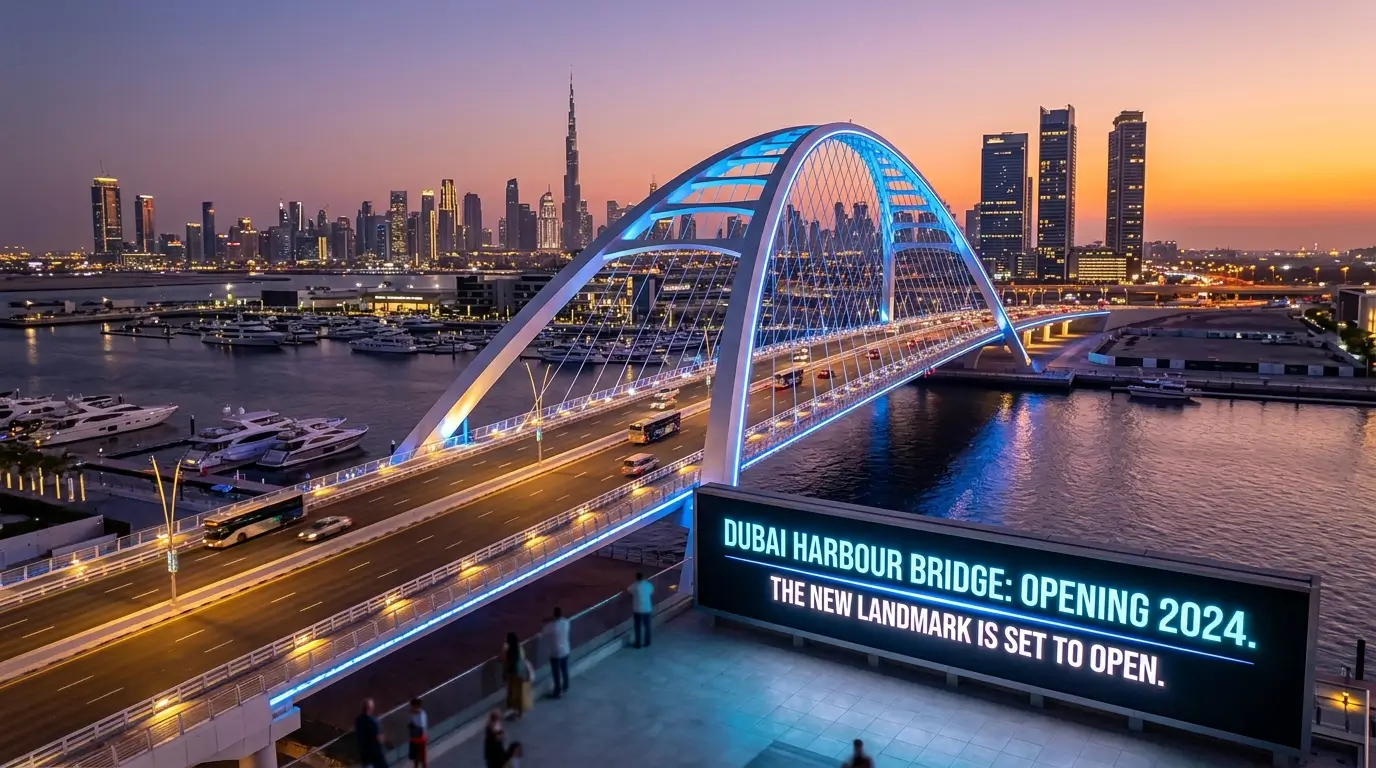
Dubai Harbour is getting a major new road connection that is set to make reaching the waterfront destination much easier.
The Roads and Transport Authority (RTA) is developing a 1,500-metre bridge linking Dubai Harbour directly with Sheikh Zayed Road. The project is designed to improve traffic flow, increase road capacity and create a more convenient route for residents, visitors and commuters travelling to the area.
The project was initially expected to be completed in the third quarter of 2026. By June, however, construction had reached 90 percent, with the RTA confirming that traffic would begin opening in phases.
A Direct Route Into Dubai Harbour
The new bridge has been designed to create a direct entry and exit connection between Sheikh Zayed Road and Dubai Harbour.
It starts at Interchange 5 on Sheikh Zayed Road, close to the American University in Dubai. From there, the route continues through the Al Naseem Street and Al Falak Street area before crossing the intersection of King Salman bin Abdulaziz Al Saud Street and extending towards Dubai Harbour Street.
The new alignment should make the journey easier for drivers approaching from different directions on Sheikh Zayed Road.
Rather than relying on a series of existing local roads, motorists will have a dedicated connection leading directly towards the waterfront district.
When Is the Dubai Harbour Bridge Expected to Be Completed?
The project’s completion has been progressing steadily throughout 2026.
In January 2026, the RTA announced that construction had reached 65 percent, with completion expected in the third quarter of the year. The authority also said that 90 percent of utility works intersecting with the project had already been completed.
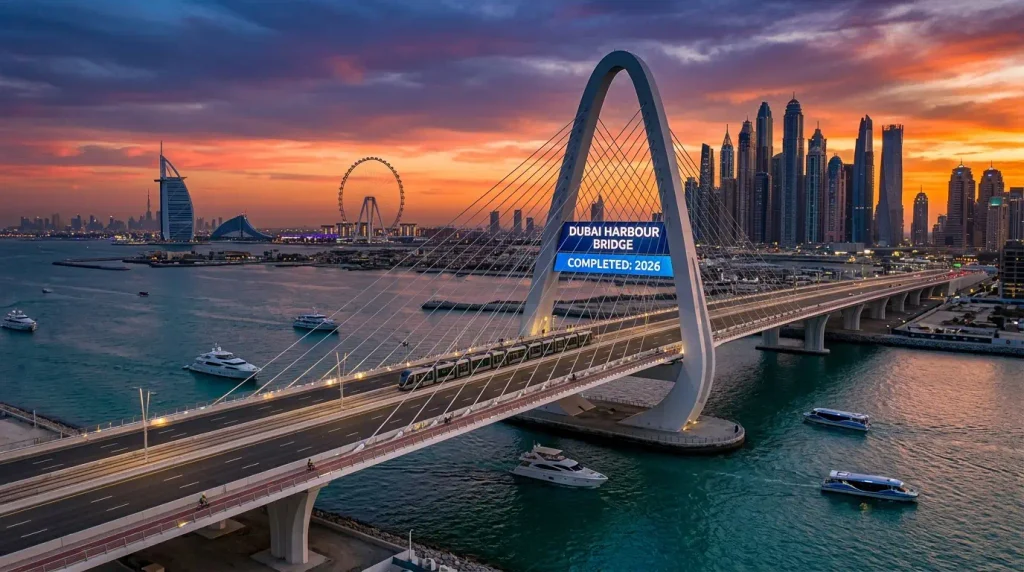
By June 7, 2026, overall construction had reached 90 percent.
At that point, the RTA announced that traffic would be introduced in phases, with the first movements from Sheikh Zayed Road towards Dubai Harbour scheduled to open during June and additional movements planned for July.
The Bridge Will Carry 6,000 Vehicles Every Hour
The infrastructure has been designed for a substantial volume of traffic.
The new bridge will have two lanes in each direction, with a total capacity of approximately 6,000 vehicles per hour in both directions.
That extra capacity is particularly important for Dubai Harbour, where residential, leisure, retail and marine developments continue to attract visitors.
A Three-Minute Journey Could Replace a 12-Minute Trip
The expected reduction in travel time is one of the main reasons the project has attracted attention.
The RTA says the bridge will reduce journey times from approximately 12 minutes to three minutes.
That means the relevant journey could be cut by around nine minutes under the conditions used for the project’s assessment.
For people who regularly visit Dubai Harbour, the difference could be particularly noticeable during busy periods.
Four Intersections Are Part of the Project
The bridge is only one part of the wider infrastructure upgrade.
The RTA is also carrying out improvement works at four key intersections along the corridor. These include Sheikh Zayed Road’s Interchange 5, the Al Falak Street and Al Naseem Street intersection, the King Salman bin Abdulaziz Al Saud Street and Al Naseem Street intersection, and Dubai Harbour Street.
These supporting roadworks are intended to make sure traffic can move more efficiently before reaching the bridge and after leaving it.
That is particularly important because improving one bridge alone would not necessarily solve congestion if traffic were then forced into bottlenecks at nearby junctions.
Dubai Harbour Is One of Dubai’s Major Waterfront Destinations
The new road connection is being built to support a destination that has become increasingly important to Dubai’s tourism and leisure landscape.
Dubai Harbour is located between Bluewaters Island and Palm Jumeirah, close to major landmarks including Burj Al Arab. The district features residential, retail and entertainment offerings and is known for its large-scale marina facilities.
The RTA describes Dubai Harbour as one of the emirate’s leading modern waterfront and tourism destinations.
As the area develops further, improving road access is expected to become increasingly important.
More Homes and Developments Are Coming to the Area
Dubai Harbour is not standing still.
According to the RTA, a development project spanning around 1.5 kilometres is underway and includes a residential complex comprising 24 towers and approximately 7,500 residential apartments.
That scale of development makes efficient road infrastructure particularly relevant.
Construction Has Involved Thousands of Workers
The bridge project has required a significant construction operation.
By June 2026, the RTA said around 1,400 engineers and workers were working across 12 teams. More than 4.2 million work hours had been recorded since the start of construction.
The project had also used more than 45,000 cubic metres of concrete and 8,273 tonnes of steel.
Other project figures include 254 piles, 66 bridge columns and five bridge ramps, highlighting the scale of the infrastructure being built.
Access From Both Sides of Sheikh Zayed Road
The new route is intended to benefit motorists coming from different directions.
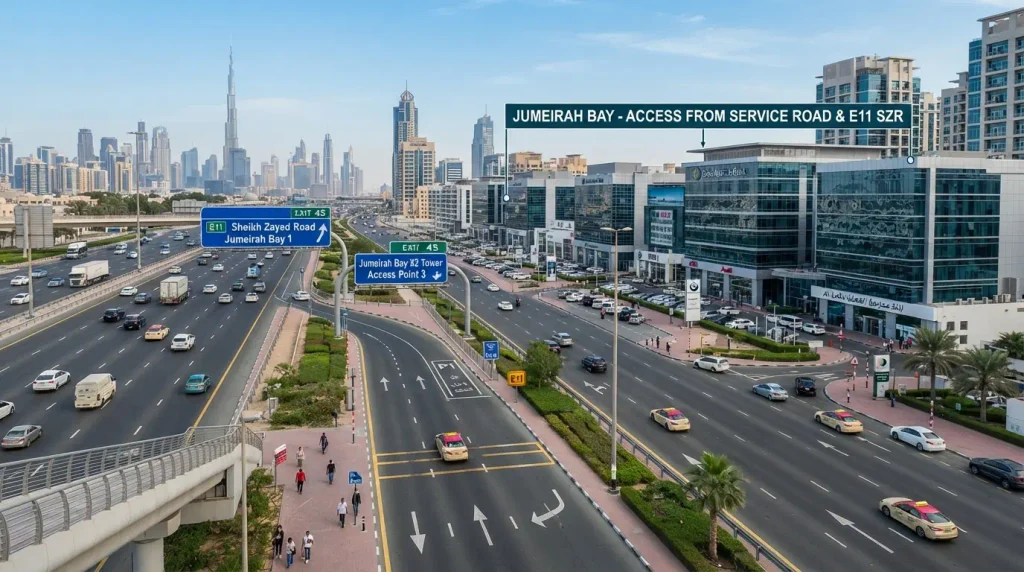
As part of the phased opening plan, the RTA said traffic travelling from Sheikh Zayed Road towards Dubai Harbour would be allowed to access the new connection from both the Deira and Jebel Ali directions.
That gives the project relevance for a wide range of Dubai drivers rather than only people living close to the waterfront.
It also provides a more direct option for visitors arriving from across the wider city.
A Partnership Between RTA and Shamal Holding
The project is being delivered through cooperation between the Roads and Transport Authority and Shamal Holding.
The RTA has described the project as a public-private partnership, linking the development of transport infrastructure with Dubai Harbour’s long-term growth.
For Shamal Holding, improved connectivity supports the continued evolution of Dubai Harbour as a major seafront destination.
What Will Change for Dubai Harbour Visitors?
For visitors, the main difference should be a simpler drive to the waterfront.
Dubai Harbour attracts people for restaurants, events, residential communities, boating and marina activities. A direct route from Sheikh Zayed Road can make these destinations easier to access, particularly for drivers unfamiliar with the surrounding roads.
The additional capacity may also become useful during busy evenings or major events, when demand for access to the district increases.
The bridge will not remove all traffic from the area, but it provides a new and more direct route designed to improve overall connectivity.
Dubai Harbour Bridge FAQs
The RTA says the bridge will have capacity for approximately 6,000 vehicles per hour in both directions.
The bridge begins at Interchange 5 on Sheikh Zayed Road, near the American University in Dubai.
The RTA initially said the project was expected to be completed in the third quarter of 2026. By June 2026, construction had reached 90 percent and traffic openings were being introduced in phases.
The project is being developed by the Roads and Transport Authority in partnership with Shamal Holding.
Final Thoughts
Dubai Harbour’s new bridge is set to give motorists a faster and more direct connection between one of the city’s major waterfront destinations and Sheikh Zayed Road.
The 1,500-metre bridge will feature two lanes in each direction and is designed to handle around 6,000 vehicles per hour. The RTA expects the project to reduce the relevant journey time from around 12 minutes to three minutes.
With construction reaching 90 percent by June 2026, the RTA began planning phased traffic openings rather than waiting until the original third-quarter completion window.
Alongside the bridge, four key intersections are also being upgraded, creating a wider improvement to the road corridor leading into Dubai Harbour.